
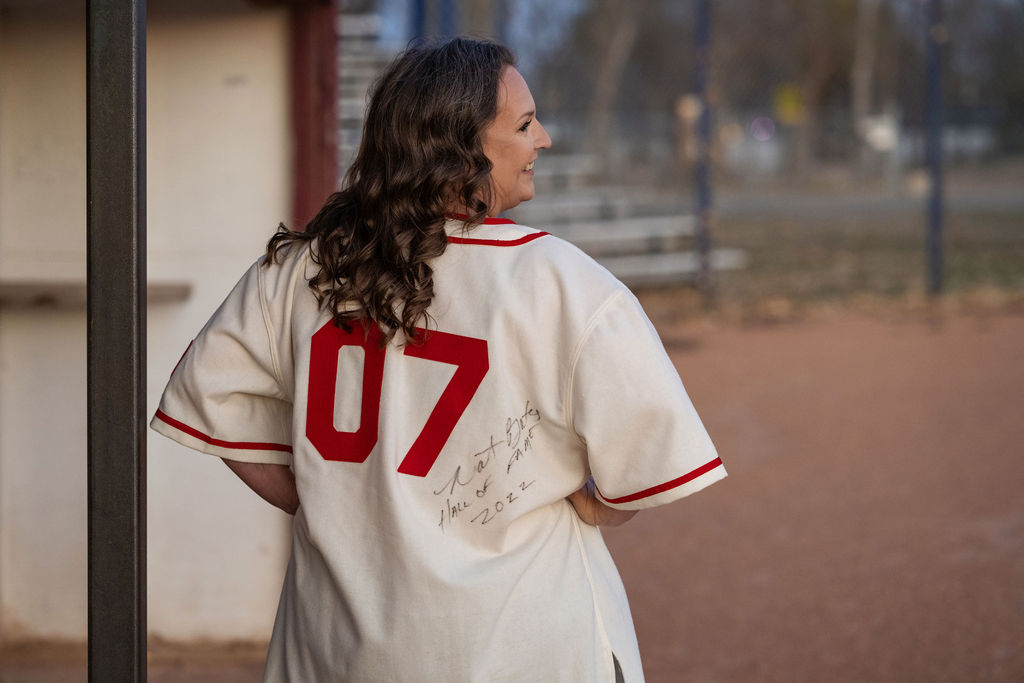
The first thing I want you to see in my blog is my most treasured Saskatchewan baseball keepsake – my Rockets Jersey. The signature of Nat Bates, a pitcher from the 1952 team, marks the end of my two-year journey researching, designing, and creating an exhibit for the Indian Head Museum. Many serendipitous moments happened during this time, pushing me further down the glorious rabbit hole of Saskatchewan baseball history.
My beginning and journey are summed up with the speech I prepared for the exhibit opening in June 2022:
Welcome to the Indian Head Museum and Archives!
It’s so amazing to see all of you today, and to those who have traveled far away to celebrate with us – thank you for coming. Each of you here has a personal connection to The Rockets, and this day is for you to connect and take your time viewing the exhibit.
I would also like to recognize that the space you are in is 115 years old this year – Happy Birthday to Our Historic Fire Hall!
When covid hit two years ago, fellow board member Janine Moses-Randle and I looked at it as a half-full opportunity to revise and renovate the main floor.
We wanted the exhibits to tell a story rather than just a place to display artifacts. One of the reasons why I joined the board was to learn more about The Rockets, and I knew that this piece of history had to be included in the redesign.
The Rockets’ story is a multi-layered narrative:
- Baseball: Growing up in Saskatchewan, baseball was the Summer sport everyone could play, and we had wide-open spaces to do it.
- The Vision of One-Man: Jimmy Robison, who had a dream to make Indian Head the “center” for Western Canadian Baseball,
- Community Support: Jimmy’s dream would never have happened without the support of the community and area.
- The Tournaments: The biggest in ‘48 and ’49.
- The Players: Some were Negro League alums, and some were unrecognized for their talent by the major leagues. These players came from the US, where racial segregation was a daily reality.
This era gave Indian Head and Saskatchewan some of the best baseball they had ever seen.
In the beginning, I felt like I needed to figure out how to start this project on something that happened over 70 years ago. Ken McCabe, the man I would have loved to talk to, passed away.
There was rarely a sporting event where one wouldn’t see Ken McCabe with his camera around his neck, pen, and paper in hand. Between getting the “scoop” for next week’s local newspaper, he was visiting with the crowd, cheering on the teams, and talking about the community he loved so much. He lived and breathed athletics, dedicating his life to preserving local and provincial sports history.
Ken, without question, would have been involved in this project. He would have been my sounding board for ideas and to know if I was going in the right direction with my research. But Ken guided me to connect with the right people.
The stars started to align, and good fortune headed my way with the introduction of two gentlemen: Max Weder and Jay-Dell Mah.
Almost two years ago, Max, a lawyer from Vancouver (but originally a Saskatchewan boy), contacted the museum. One of his life passions is pre-1970 Western Canadian Baseball. He was approached to write an article on The Rockets for an upcoming book by the Society of American Baseball Research, with whom he is a member. Combing forces, we worked together to uncover their story.
The second is Jay-Dell (or JD) Mah, a former radio and television news reporter for the CBC in Toronto. He grew up in Lloydminster, where he was a bat boy for the Meridians. He co-authored a book on Black baseball players in Canada and was inducted into the Baseball Hall of Fame in 2010.
JD, in his retirement, runs www.attheplate.com, an invaluable resource for early Western Canadian Baseball.
The other extraordinary person in my journey with The Rockets story is Carol Lafayette-Boyd from the Saskatchewan African Canadian Heritage Museum. She was integral in connecting with Nat Bates and Willie Reed, some of the last surviving Rockets players. Their stories are essential to their virtual museum and Black history in Saskatchewan. Carol would arrange Zoom meetings with Nat and Willie and act as liaisons. We couldn’t have done it without you.
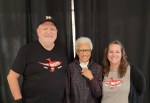
All of you here today have somehow contributed to the story of The Rockets. Max and I have reached out to you, and we are grateful for your input and guidance. All of you are now the keeper of this story, which I hope you share with the next generation of your family.
There is a saying that I find most powerful: “We are all stories in the end; make it a good one.”
And you have a great one to share!
And lastly, the icing on the cake is when Lorne Harasen nominated The Rockets players from 1950 to 1954 to be inducted into the Saskatchewan Baseball Hall of Fame in August in Battleford.
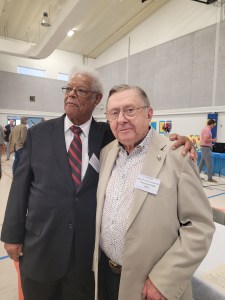
The legacy of The Rockets is an inspiring piece of history and is here to remind everyone to dream big, work hard, be kind, and PLAY BALL!

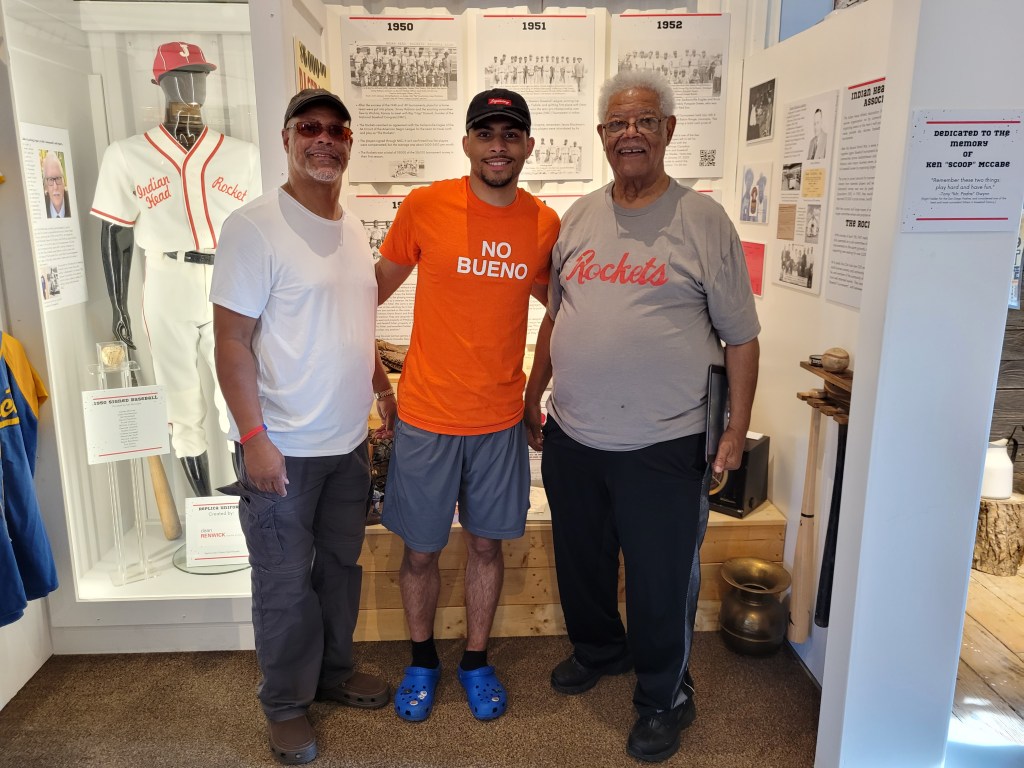
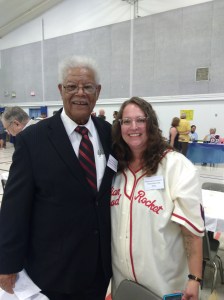
At the time of the opening, we didn’t know that Nat and his family were coming to Canada for the induction ceremonies in Battleford. It brought everything I had done to life when a surviving Rocket visited the museum and experienced the exhibit. – A true honour!

 Home Runs & Dirt Roads