
For Rich
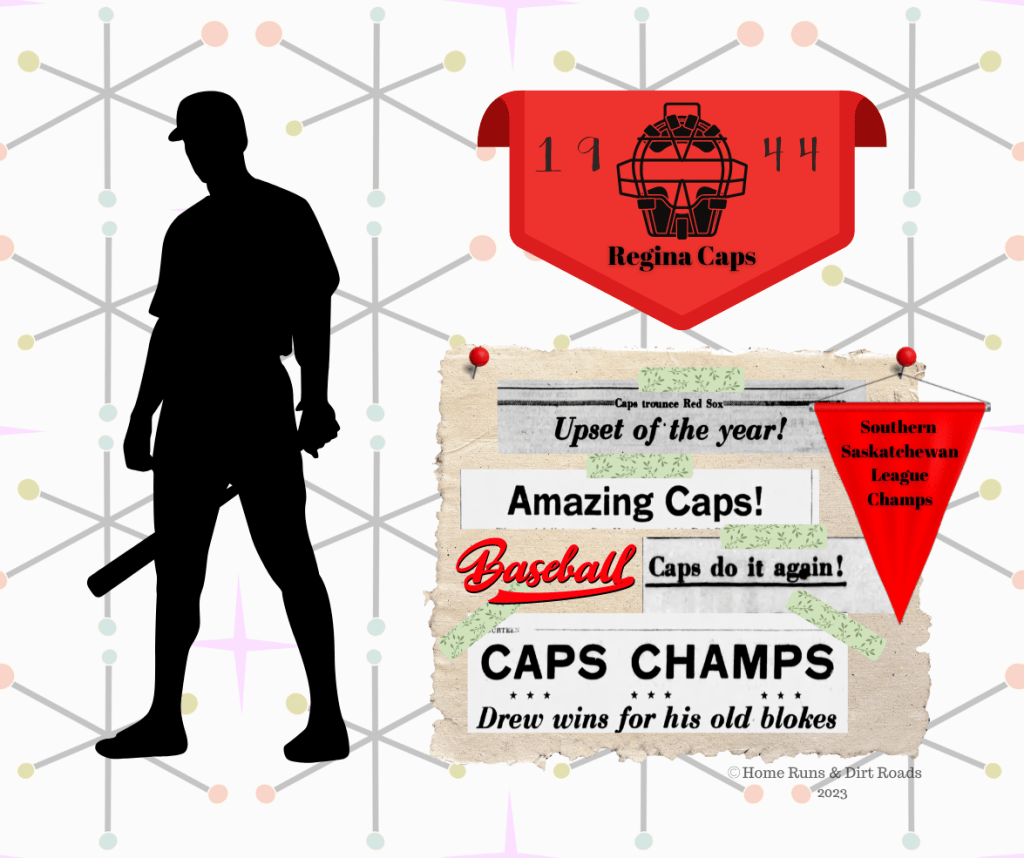
This is the underdog story of veteran player/umpire George Drew and his rag-tag team of “old blokes” who came out of nowhere, defying all the odds, and in storybook fashion, went on to capture the 1944 South Saskatchewan League championship title.
“If I can’t gather up a bunch of broken-down ball players that could lick the daylights of the bums playing out here now, I will promise to never again pass through these gates.” – George Drew
Baseball and World War II
As the world went to war, so did baseball. It was reflected harshly in the rosters: the eligible men who usually played were either drafted or enlisted to help fight overseas. So, these positions were filled by men who stayed behind because they were either too young for the draft, seen as unfit, or too old to join the battle. Gathering enough players was a challenge, let alone employing enough teams to form a competitive and engaging season for the fans. The Saskatchewan League at the start of 1944 consisted of only four teams, including Doc Hughes’ Regina Red Sox, Father Murray’s Notre Dame Hounds, and two military: the Regina Army Garrison and the Provost Corps. To confuse things, these four teams were also in the Regina City Baseball League.
The Season Starts
In May 1944, whispers of adding a new team were starting to circulate, but no other formal mention of who or where this team was coming from. The predicted crew to win was the Notre Dame Hounds, whose star players were the Metz brothers. Nick and Don were nationally known for their prowess in professional hockey, playing with the Toronto Maple Leafs.
By June 29th, this forecast was coming true, with the Hounds in a strong lead with 8 wins and 0 losses. The Red Sox were in second place with 6 wins, Provosts third, and the poor Army Garrison pushed further into the cellar with 0 wins.
The season was humming along until an unexpected turn of events announced in the July 26th edition of the Leader-Post titled: “Baseball loop has new club”, which threw a curve ball into the season:
“A new entry was ushered into the Southern Baseball League Tuesday night following an announcement that Army Provosts have been forced to withdraw their squad from the balance of the schedule.
Caps [Regina Capitals] will be the new member of the loop, with the veteran player and umpire George Drew at the helm.”
The Army Provosts unexpectedly withdrew because of current and impending personnel transfers, making a stable roster impossible. Regardless, losing a team in an already small league and what was felt by fans as a lackluster season, could hurt the overhead costs even further. This unexpected turn of events and adding a new team should have created excitement. Instead, fans and the local sportswriter were skeptical of the aging Drew’s ability to gather a group of players from the already slim pickings of eligible men. Labeled as a “chunky bespeckled ex-star,” the people laughed.
George Drew was a baseball veteran, having played outfield and pitcher for the Wilcox Cardinals in the late 30s and throughout the 40s. Hanging up his cleats temporarily, he moved behind the plate and was umping for the Saskatchewan Baseball League when the Provosts pulled out, prompting Drew to jump in. Often the merits and wisdom gained from having a consistent and long career are overshadowed by the idea that athletics are reserved for the young and fit. Drew was ready to prove everyone wrong.

Using his experience and established contacts, he created his squad utilizing a mix of young and old: Al Potter, a third base whiz from Scott Collegiate, alongside veteran Johnny Helfrik, former Moose Jaw and Red Sox performer, with Ed Smith and his star pitcher Don Devine of the 1943 Commandos.
Making their debut the day after the announcement, the Caps were tested against the more youthful Notre Dame Hounds at Park De Young (Taylor Field). They were strong out the gate for five innings, but things took a turn that stung when Notre Dame beat them 13-5.
Their second appearance was equally disappointing, with the Red Sox sitting Drew’s team down with a 5-2 verdict. The third time was not a charm, with the game ending in a 4-4 tie against the Army Garrison. They finally won their first game against the Garrison team 7-2, and the next day won again against league favourites Notre Dame in a close 4-3 game. Fans were starting to get excited about this late entry dark horse:
“The surge of Drew and Co. adds flavour to next week’s play-offs, and although they may not win any prizes, they can at least say they woke up the Park de Young customers who had been snoozing most of the summer…”
The Final Countdown
After the Caps started winning, Drew and his players were unstoppable:
“…after losing the first two games of their semi-final series against the champions of 1942 and 1943, the Regina Red Sox, the Caps responded to the threat of elimination by roaring back to win three in a row, moving on to face the Notre Dame Hounds who had the Southern League’s best regular-season record. As a decided underdog, no one gave them much chance to upset the pennant-winners. Still, after seven hard-fought games, this rag-tag group of faded veterans rejects from other teams and untested newcomers, including a 16-year-old third baseman out of the high school ranks, prevailed as 1944 Southern League titlists, a Cinderella finish if there ever was one.”
Underdog Drew Gets the Last Laugh
“Caps won it all on Wednesday and burly George was the guy who made it stick. His lone pitcher cracked up and Drew ambled out to the mound. He fed the Hounds inside balls and outside balls, low ones and high ones, but never one down the old alley. He stopped them cold, not because he has so much on the horsehide, but because he was using the old bean, Proving that on occasion a strong mind and a weak arm can accomplish more than a strong arm and a weak mind.”
George Drew, as a veteran athlete, automatically put him in the category of an underdog. A stereotypical label that reflects ageism in sports that still happens today. He never once believed it and, in true underdog mentality, loved being underestimated and overlooked. Drew and his rag-tag team worked harder, smarter, and faster than the competition because they knew they had to. He came along at the right time to give hope, boost morale with his can-do attitude, to remind society that the “oldies and leftovers” still have something to contribute.
Cheers,
Robyn
Sources:
Leader Post Newspaper
Attheplate.com
Thank You to Jay-Dell Mah for allowing me to use his image.
Written by Robyn Jensen (May 2023) for her blog Home Runs & Dirts Roads

 Home Runs & Dirt Roads