You see their faces in the photos, either standing or sitting in the team photos. There is sometimes a name but most often not. The bat boys were the ones who kept the wheels turning before, during, and after the game. In return, they befriended the players, many of whom became big brothers and mentors. I haven’t found a lot of written work about their experiences and but through my research, I connected with the other half of the dynamic duo at attheplate.com – Rich Necker. Rich, like Jay-Dell Mah is a walking encyclopedia of early Western Canadian Baseball. He was also the bat boy for the 1951 California Mohawks and the 1952 Florida Cubans, whom he affectionately calls his Los Cubanos. I asked him to share his memories of being a bat boy during this exciting time of 1950s Saskatchewan baseball.
“I was just a skinny kid in the late 1940’s and early 1950’s when I became enamored with the game of baseball. The advent of television was still a few years away from becoming a major component of our existence on the prairies. Live entertainment, in particular sporting events such as baseball games, were big events and were well attended. More and more touring teams featuring black stars wound up north of the border as the established negro leagues in the U.S. began to dry up with the slow and gradual integration of major league baseball. Many of these highly skilled players were looked up to by the generation from which I emerged and we used to arrive at the ball park hours before game time in order to vie for the honor of being chosen as batboy for the barnstorming visitors. Luckily, I wound up with probably more than my share of such assignments.
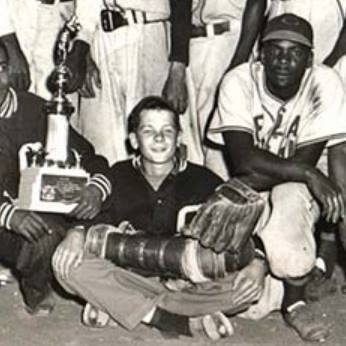
Photo Credit- Rich Necker
The Indian Head baseball tournament was considered the most prestigious within Saskatchewan and, with pre-arranged hotel accommodation, I was able to attend both the 1951 and 1952 events, played on three separate diamonds, from start to finish. As fate would have it, I was fortunate enough to shag bats for both the ultimate tourney winners, the ’51 California Mohawks, masquerading as a Medicine Hat entry and, of course, the youthful and exciting 1952 Florida Cubans for whom I developed a special and lasting affinity. Los Cubanos played the game the way it was intended to be played, with passion, hustle and intensity no matter the score. Constant infield chatter in Spanish seemed to bewilder their foes. Their exuberance often annoyed opposing teams who accused them of being hotdogs or showboats. They went on to capture the 1952 National Baseball Congress championship of Saskatchewan, downing the Indian Head Rockets two games straight in the best-of-three final series.
The duties of shagging bats for a baseball club began by hauling the collection of bats, catcher’s equipment and practice baseballs from the team bus to the dugout prior to the game, lining the bats up in a bat rack according to length and occasionally playing catch with one of the player participants during the warm-up period. The reverse, in terms of packing up the equipment at game’s end for return to the bus, normally ended the day’s work.
There were no batting helmets, batting gloves, weighted donuts for bats or pine tar used in that era and defensive players, with the exception of the catcher, routinely tossed their gloves on the playing field between half-innings as they jogged in to take their turn at bat.
Had to be careful/cautious during/immediately following a player’s plate appearance when that player transformed from a batter to a runner in scampering to the initial sack. Important not to react too quickly in picking up discarded lumber near the dish until the play on the diamond was completed. Likewise, in a scenario with baserunners already occupying sacks on the diamond, to delay collecting the abandoned baton at the platter when a potential play at that station was a possibility so as to avoid any interference call. After the third out had been made by the opposition, if the catcher had been a stranded baserunner, I was expected to assist him in quickly strapping on his shin guards and belly pad as umpires back in the day wanted hustle and demanded a rapid start to the next inning. Occasionally, a relief pitcher would ask me to grab a spare catcher’s mitt for soft-toss behind the dugout during the early portion of his warmup routine but once things got serious when sharp-breaking pitches and the 95-mile an hour heater dominated, the back-up catcher would take over.
Pitchers always batted in that day-and-age and since many of them were relatively adept with the stick, time would be called on cool days upon their reaching base as I sprinted out to whatever base they were occupying with a jacket for wear during their potential circling of the bases.
Never travelled with the team into Alberta nor made overnight trips within Saskatchewan but recall several short jaunts into Estevan, Yorkton, Regina, Kamsack and Moose Jaw. When the ’52 Indian Head tournament was in progress, had a room in the hotel directly above the extremely noisy men’s-only watering hole…
Can’t remember what, if any, remuneration was received but would have been a pittance like 25 or 50 cents a game although did acquire a team jacket which was far more important. Los Cubanos were an exceptionally great team and I was just honored to be associated with many of these players who were, at that time, my baseball heroes.”
Thank you to Rich for sharing his stories and memories!
Robyn
Written by Robyn Jensen (May 18th, 2023) for her blog Home Runs & Dirts Roads

 Home Runs & Dirt Roads