Part I: The Arrogant Teenagers
When I was 16, I played on an all-girls baseball team, and at the end of the season, we were supposed to have an exhibition game with our parents. I can’t remember if Dads were invited, but it was just the Moms that came. They were running short to make up a team, so I asked my Grandma, who would have been in her early 60s, to play. She was very athletic, and she loved baseball. So why not? Grandma said yes, she would join.
The evening came, and the “Moms plus one Grandma” team showed up. Now, being 16-year-old arrogant teenage girls, we were sure we would beat and whip our older competition without any problems. When it came time to choose the positions, my Grandma stepped up and picked the outfielder. She didn’t have a glove and declined to take one when offered. My teammates and I were gobsmacked that she was willing to catch a baseball with her bare hands. Grandma said, “That’s how we used to do it back in the day.”
And so the game commenced, and the “Moms, plus one Grandma”, whipped us into the ground—not only whipped but stomped, buried, dug up, and whipped again. We were so embarrassed that these “old ladies” beat us. I learned two lessons that day. First, never underestimate the skills, power, and wisdom of older women. Second, my Grandma’s hands were made of steel.
But how did they get that way? How was she able to play without a glove?
She tells me that she was always active but, like most early settler farm families living on the prairies, had no money. The kids made do with what they had, which, like playing baseball, was with a stick and ball. Baseball was the ideal sport to play in the wide-open landscape of the prairies. Grandma said that it was during recess at the one-room schools that she got her baseball experience, playing with the boys. Gender didn’t matter as long as you could “give it your all” during the game. At the end of the year, all the schools in the district would get together for a day to play and compete against one another.
I think about her playing sports in rural Saskatchewan during the late 1930s and early 1940s, away from the pressures of societal norms placed on young women of that time. She was just a kid who played sports. Being able to compete added to her confidence and independence, which extended into other branches of her life, including a career in teaching before marriage.
Farmlife for girls interested in sports created space and opportunity for them to express and explore their athletic side. It may have been more accepted because women taking on physical roles was expected (and mandatory) to operate a farm. Women would drive tractors, do gardening, butcher, remove stones from the field, etc. I see a similar story researching other female athletes from that era who grew up in rural areas, such as the women who played with the Saskatoon Pats over the years. Some of which became very famous.
Part II: Saskatoon Pats
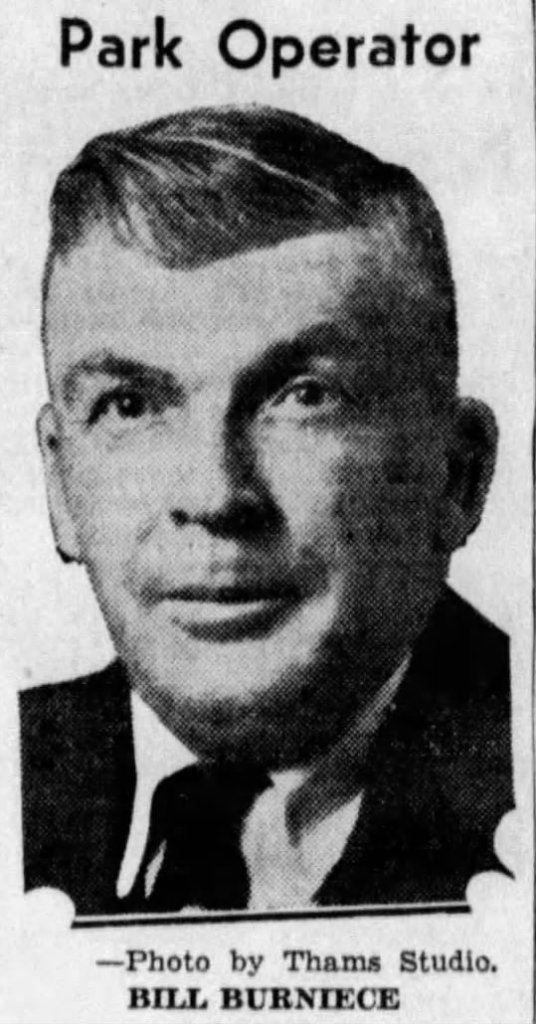
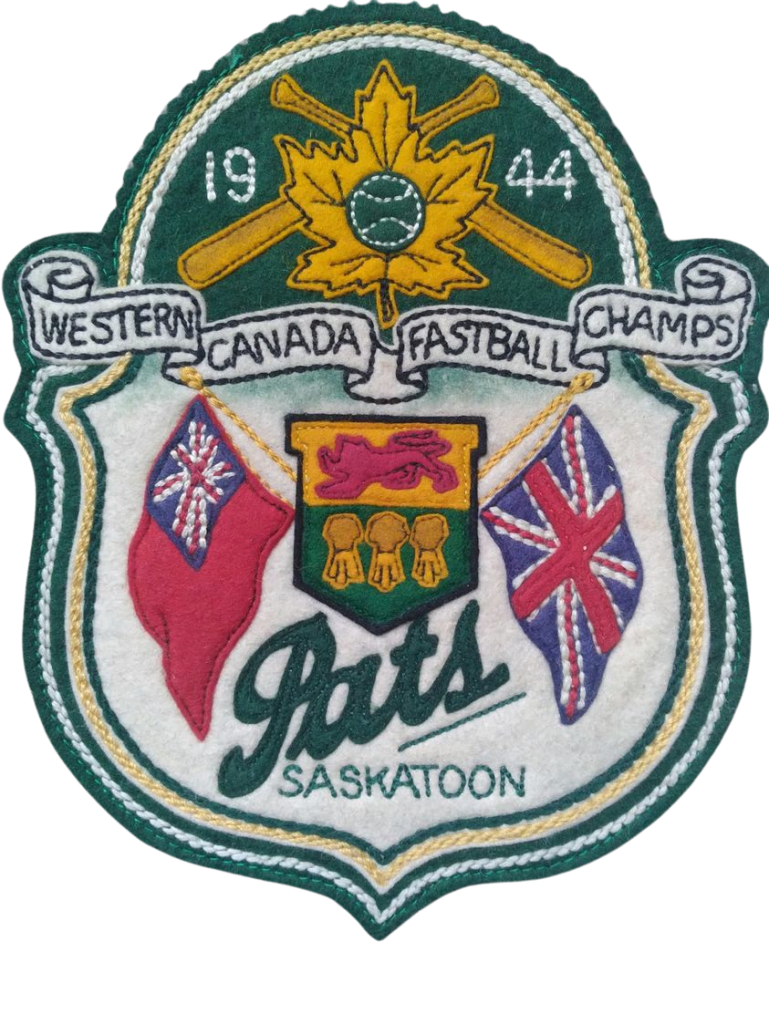
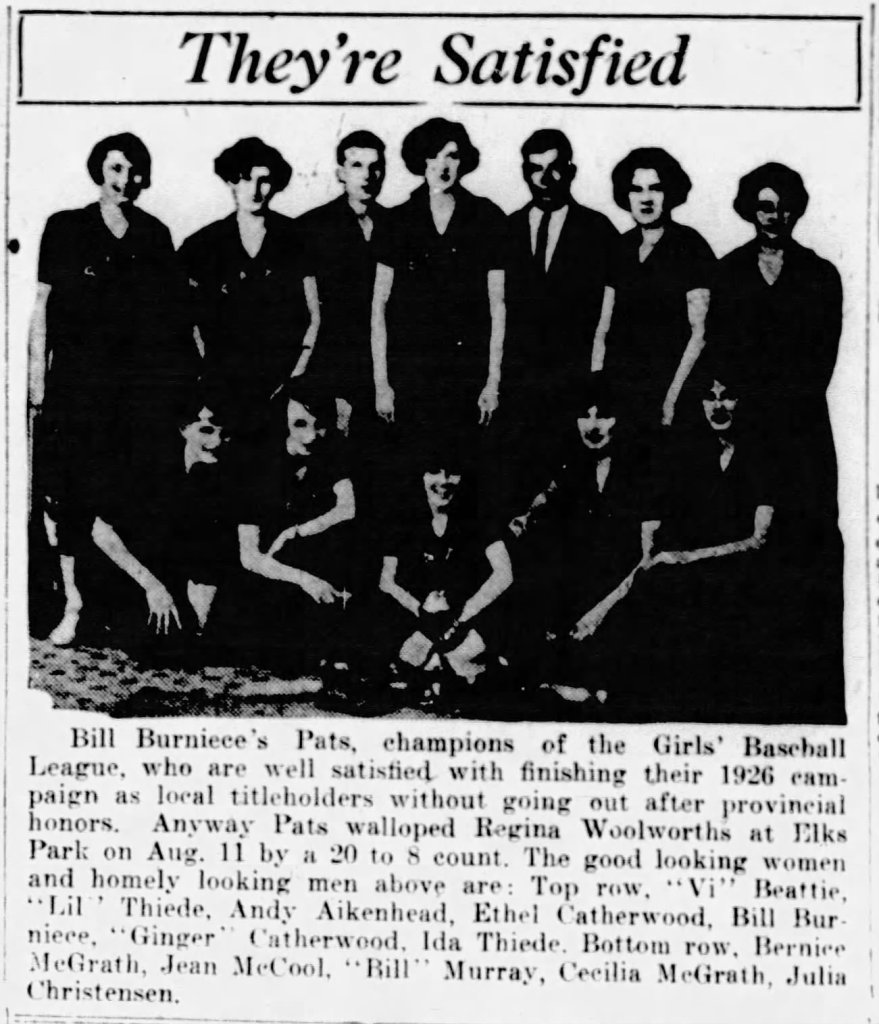
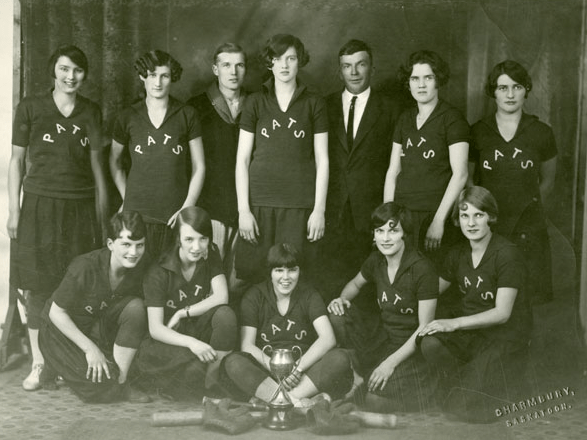
In 1924, Saskatoon business taxi owner Bill Burneice started a team called the Saskatoon Pats. They played baseball for the first five years and were the dominant team in the city Ladies (Girls) Baseball League. Unable to find other suitable competition, the team switched to softball and fastball to widen their opportunities. Before switching, in 1929, they won the city title and the Saskatchewan and Alberta provincial championships. In 1944, Burneice’s team won the top prize and walked away as Fastball Western Canadian Champions.
Burneice’s team included famous athletes such as high jump world record breaker and Olympic champion Ethel Catherwood, known as the “Saskatoon Lily.” Lucella MacLean Ross, Muriel Coben, and Elsie Wingrove also went on to play for the All-American Girls Baseball League.
Ethel and the 1926 Saskatoon Pats
Ethel was born in North Dakota and moved to Scott, Saskatchewan when she was a year old with her family to farm. They later moved to Saskatoon, where she became noticed for her track and field abilities through Bedford Road Collegiate. The Saskatoon Star Phoenix labeled Ethel a “natural-born runner and jumper,” adding that she possesses an “unbounded confidence in her ability.”
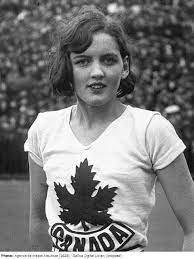
Along with competing in track, Ethel played basketball and baseball with her sister Geneva (nicknamed Ginger) on the Saskatoon Pats. It wasn’t until late August that the newspapers picked up the story of Ethel setting the record for the national high jump in July. So Ethel flew under the reporters’ radar for the season, only popping up in the box score summaries. The rivalry between Pat’s pitcher, Julia Christensen, and the opposing Elites pitcher Winnie Grady, captured the fans’ interest.
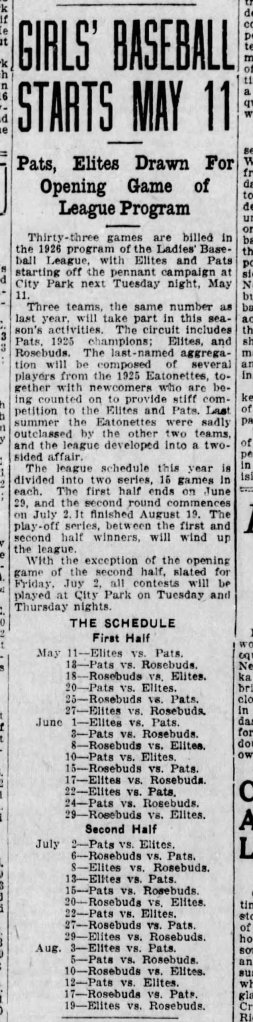
The team to beat was Jimmy Girgulis’ Elites, the Ladies (Girls) Baseball League champs from 1925. The league was a tiny circuit consisting of only three teams: Saskatoon Pats, Elites, and Rosebuds (a new team emerging from last year’s Eatonettes). While there was promise with the Rosebuds, predictions of intense games were to be between the Pats and Elites, as mentioned in their season opener:
“The interest taken in the girls’ competition during the past few years promises to be sustained again this summer, and many baseball fans are planning to gather at City Park this evening to see the female of species at their diamond antics.
Both clubs in tonight’s game will depend on the pitchers that carried them through such a successful season last year. Winnie Grady will be on the mound for the championship team and the fact that she knows how to dish them up needs little mention. No less interest will be taken in the appearance of Julia Christensen in the pitcher’s box for the Pats. Both pitchers have great records behind them and a duel from the mound is looked for at the park.” (Star Phoenix, May 11th, 1926)
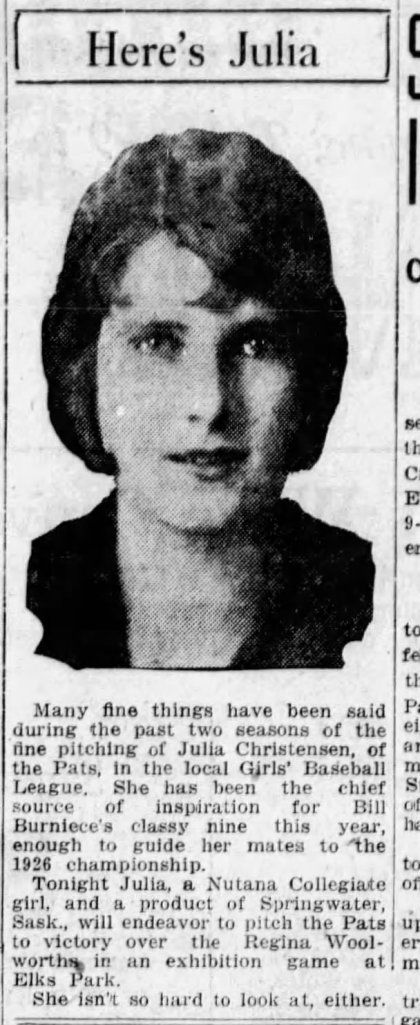
Saskatoon Pats pitcher Julia Christensen, another farm girl from Springwater, Saskatchewan, moved to Saskatoon and attended Nutana Collegiate.
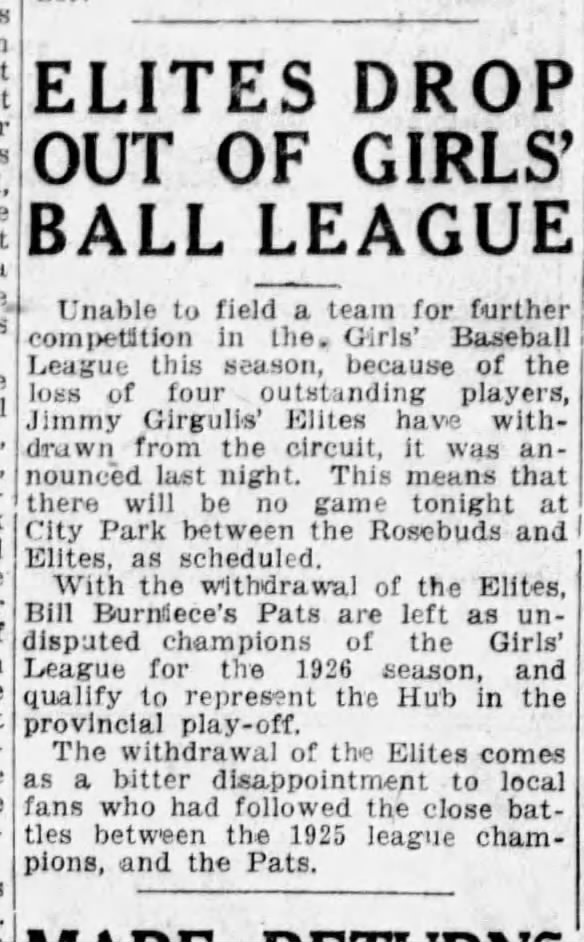
The season was split into two series: the first ending on June 29th and the final on August 19th. As predicted, the Rosebuds did not fare well with their counterparts, and the last game on the 29th ended with the Elites winning 16-9. The second series was going well until August 10th, when it was announced that the Elites were dropping out due to losing four players. The Saskatoon Pats were declared the League champions.
Part III: Famous Players on Saskatoon Pats After 1926
After the team switched to softball and fastball in the 1930s and 1940s, other girls with rural connections joined. The Pats were a stepping stone before they were scouted to play in the All-American Girls Professional Baseball League (AAGPBL).
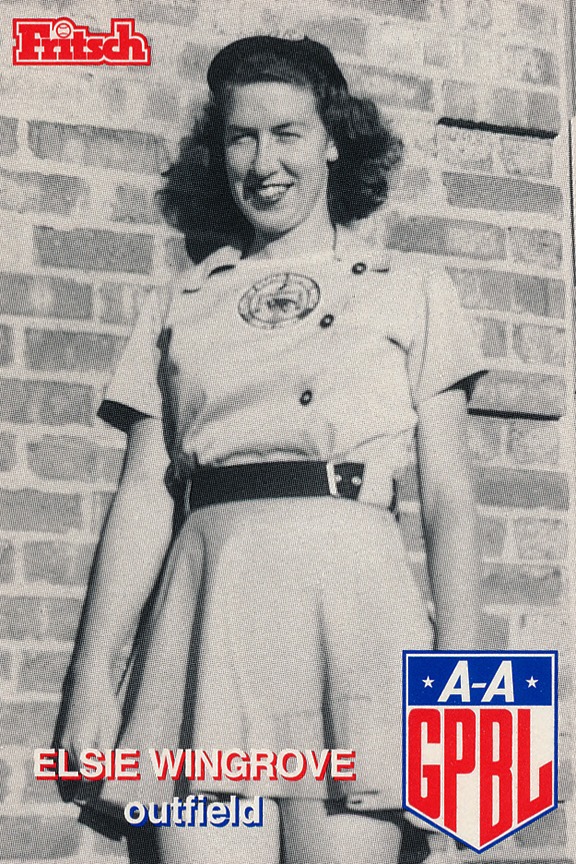
Elise Wingrove
https://www.aagpbl.org/profiles/elsie-wingrove-earl-windy/403
“While growing up in a farm, Wingrove accustomed to play baseball with her two brothers and sister and father. Every Sunday the neighbors congregated at our farm; the kids played ball in the pasture, the men played horseshoes in the laneway and the ladies picked fruit from our garden, she recalled in an interview.” (Wikipedia)
Elise played for the Fort Wayne Daisies and the Grand Rapid Chick from 1946 to 1947. She has been inducted into the Saskatchewan Baseball Hall of Fame, the Canadian Baseball Hall of Fame and Museum, and the National Baseball Hall of Fame and Museum in Cooperstown, NY.
Muriel Coben
“Coben has been considered by researchers as the greatest softball pitcher of her era in Saskatchewan history. She led her teams to numerous regional, provincial and national championships in Canada in a career that lasted 18 years. In addition, she was a member of a Canadian women’s curling champion team and has been enshrined in several Hall of Fames in recognition of her outstanding contribution to Canadian sport.
Born in Gelert, Ontario, Coben was raised on a farm in Tessier, Saskatchewan. She started her pitching career in 1936, winning all her games as a member of the hometown Tessier Millionaires. She later played from 1938 to 1942 in Saskatoon for the Pats team, where she aroused the attention of an AAGPBL scout who signed her to a contract to play in the new league during the opening 1943 season. Coben tried to make the adjustment to the AAGPBL’s rules of play, but returned home after one year of struggling. Unfortunately, she suffered one of the worst pitching performances of the year, after posting a combined 4-16 record with the South Bend Blue Sox and Rockford Peaches, while leading the league for the most earned runs allowed (102).
She returned to the Saskatoon Pats in 1944, pitching for them two years before joining the Saskatoon Grey Cab Rambler from 1946 through 1950. In this period, Coben helped the team win three successive Saskatchewan championships (1946-1948) and two Western Canadian championships (1946-1947). In 1950 she moved to Edmonton, where she joined the Mortons ball club and aided them in winning the Canadian championship over a very strong Toronto squad in 1952. She then returned to Saskatoon, and again starred with the Ramblers until her playing days were over in 1953.” (Helen Nordquist, https://www.aagpbl.org/profiles/muriel-coben/253)
Muriel has been inducted into the Canadian Baseball Hall of Fame and the Saskatchewan Baseball Hall of Fame. She is featured in the Women in Baseball AAGPBL display at the Baseball Hall of Fame and Museum.
Lucella MacLean
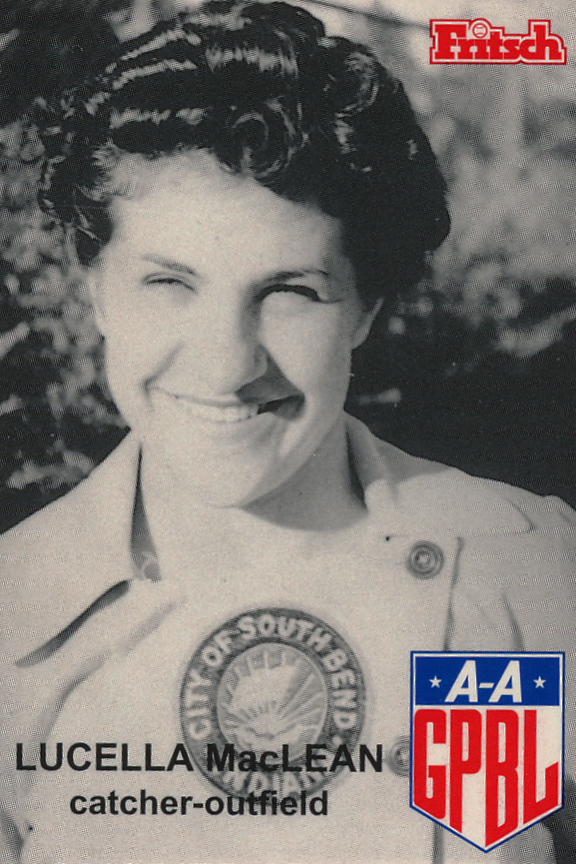
Lucella was born in Lloydminster and played for the Saskatoon Pats from 1941 to 1943. She played as a catcher, first base, and right field.
She was inducted into the Saskatchewan, Alberta, and Canadian Baseball Halls of Fame and is featured in the Women in Baseball display at the Baseball Hall of Fame and Museum.
Part IV: Legacies
Bill Burneice had a fantastic track record of finding amazing female athletes to play baseball, softball, and fastball for the Ladies (Girls) Ball League. The majority became great players because of their freedom to play on farms and in rural communities. Young girls were expected to help with physical labour, which gave them confidence and abilities when competing in sports.
Burneice’s dream of winning the Western Canadian championship happened one year before his death in 1945. I wonder if he understood how vital the Saskatoon Pats were for these trailblazing women who shattered stereotypes. They further defied societal norms that deterred most women from viewing sports as more than a sweaty, rough-and-tumble activity in the early 20th Century.
As we reflect on the Saskatoon Pats and their female athletes’ remarkable journey, let us draw inspiration from their unwavering spirit, which was inspired by their beginnings on the prairie landscape. Their determination to play and excel resonates and inspires the hearts of all who dare to dream, defy, and break barriers today.
And finally, never underestimate the power and wisdom of older women, or you might just be in for a lesson in humility (and a severe butt whoopin’). Thanks, Grandma!
Sources:
Saskatoon Star Pheonix, All-American Girls Baseball League, Wikipedia, Bibliotheque Nationale de France, & the Saskatoon Public Library
Thank you to Howard Doell for allowing me to use his image

 Home Runs & Dirt Roads