

Prologue: I have been on the Indian Head Museum (IHM) Board since 2019 and am slowly organizing the Indian Head Rockets collections. From 1950 to 1954, the organization hired black baseball players from the United States and Cuba to play as the Rockets in Indian Head. One player in particular, Chet Brewer, was an enigma because as extensive as the IHM’s collection is of Rockets photos, we did not have one of him. Chet was one of the greatest (and underrated) pitchers of his time. Compared to Satchel Paige, had Brewer been given the opportunity, he would have played in the Major Leagues.
In August 2023, a photo surfaced of Chet in our community and donated to the museum by Alan Braithwaite. Seeing him in a Rockets uniform and wearing his all-time favorite hat from his time with the Kansas City Monarchs was terrific.
Chet would have been in his 40s, and from the photo, one can see his grey hair peeking out from under the hat. Brewer, who had been a ghost for so many years, finally decided to show his face, and it’s such an honor to add this image to the Indian Head Museum Rockets collection.
He had an exciting journey getting to Indian Head in 1951. I thought sharing his story around Halloween as a scary, not-so-scary ghost story of Chet Brewer would be fun. I hope you enjoy it!
Chet loves Canada
“I toured with Kansas City Monarchs for 11 years, but I never got a real chance to settle down in Canada for a spell until 1951 when I played with Indian Head. You can’t beat these Canadian fans, especially in Carman. Why, we started off the season with three straight losses and plenty of bad weather. But the people remained kind and easy-going and waited for better things. Now we’re up in second place and I’m glad the boys are responding for those swell people in Carman…
A typical example of the Canadian spirit is the Royal Canadian Mounted Police force,” continued Brewer. “I don’t think I’ve ever seen such a group of policemen, who are so human and understanding. They try to prevent crime instead of waiting to apprehend the criminals. I’m glad I came up to Canada because everything has been so encouraging to me.” – Chet Brewer (attheplate.com)
Chester Arthur “Chet” Brewer
Brewer was 6 feet four inches tall, weighing 185 lbs, and batted from both sides of the plate. He had a fantastic ability to retain how individual players and teams like to hit.
His best pitch was his fastball or his “smoke.” However, he had other “equally devastating styles, such as the sweeping rainbow curveball, overhand drop ball, good screwball, and emery ball.” The emery ball was the result of scuffing the ball back in the days when that was legal. This dangerous combination of smarts and pitches made him an intimidating force on the mound. (Revel and Munoz, 2014)
Chet Brewer’s baseball career started in high school, and he got his first taste of professional ball with barnstorming teams such as Brown’s Tennessee Rats and Gilkerson’s Union Giants. Gilkerson and the owner of the Kansas City Monarch, J.L. Wilkerson, were close friends. In 1925, after seeing Brewer’s talent on the diamond, Wilkerson had him moved over to the Kansas City Monarchs (KC), one of the best Negro League teams of the era. (Revel and Munoz, 2014)
The Monarchs produced more major league players than any other Negro League franchise; Jackie Robinson played with the team in 1945. Brewer’s teammates were legendary: Cool Paper Bell, Satchel Paige, Buck O’Neil, and Bullet Rogan all were on the roster at the same time as Brewer. Rogan, for instance, led the team with a .381 batting average and was one of the star pitchers, posting a 20-2 win-loss for the ’25 season. Brewer was in formidable company with other pitchers such as Nelson Dean (11-3), William Bell (10-3), and Big Bill Drake (10-4). (John Holoway via Revel and Munoz, 2014)
The KC Monarchs finished the 1925 season with the best overall won-loss record in the league with a 62-23 (.729) and were the Negro League Champions against the St. Louis Stars.
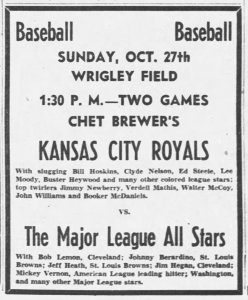
After a long stretch with KC, Brewer would travel across the US and the world, playing with other teams in the Dominican Republic, Mexico, Philippines, China, Japan, and Hawaii. Brewer had been to Canada early in his career, barnstorming with Gilkerson’s Union Giants and the Kansas City Monarchs.
Chet in Canada stirs the Cauldron
In 1950, Brewer was scouted to play with the Swift Current Indians, and it seemed like everything was set for him to play until he suddenly departed to play in South America. Money was a factor as he was reportedly offered $1300 per month to play, which in today’s (2023) money is about $16,000 monthly. (It seems high, but I’d go there too if that was the wage). The Swift Current Indians were blind-sided by this as they had already planned to head down to Montana to pick him up when he got off the train. (Revel and Munoz, 2014)
By 1951, Brewer heard Canada calling once more (or maybe the money), and this time was with the Sceptre Panthers/Nixon teams. He drove his Buick up from the United States with fellow players Pedro Osorio and Bobby Prescott to start the season in May. The Sceptre team, along with the additional talents of Hal Price and Rudy Garcia on the roster, were shaping up to be one the teams to beat:
“Sceptre, the smallest town on the continent to have a ‘big league’ team is at it again…It is also reported that Sceptre may have one of the biggest pitching names in the colored baseball world perform for them, none other than Chet Brewer, the successor to the crown once held by Satchel Paige.” (19 Apr 1951 Regina Leader-Post via Revel and Munoz, 2014)

Brewer helped the team win two tournaments in Medicine Hat and Swift Current (I wonder what it was like going back to the community Chet ditched) before he was lured away to another Saskatchewan team.
Brewer and his teammates Pedro Osario and Bobby Prescott jumped ship to the Indian Head Rockets in June. The news reported a “dirty deal,” Sceptre owner Red Nixon complained he was out $916 in expenses for bringing Osario and Prescott up from Panama. (2 Jun 1951, Medicine Hat News)
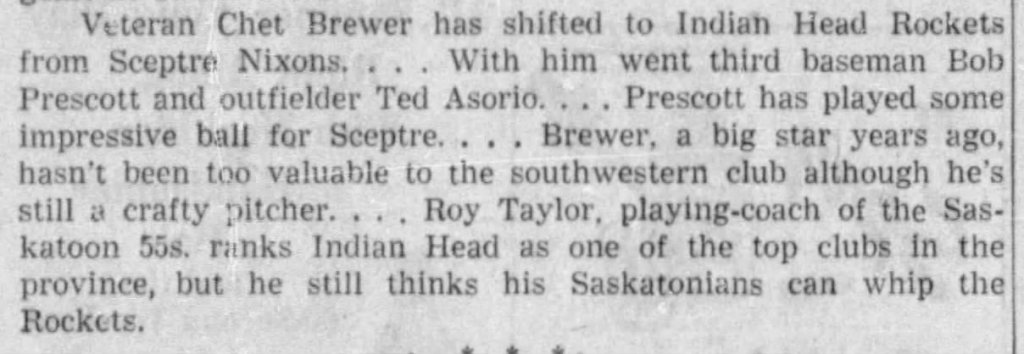
The rumours were that Brewer was paid a large sum ($900) to move to Indian Head. George Maffahy, who played with the Sceptre, downplayed the anger felt by Nixon and said it was just the nature of the business. (Maureen Ulrich – George’s Maffahy cousin). Whatever the reason was, it created quite the competition for the rest of the season between Sceptre and Indian Head teams.
Brewer and some of his new Rockets teammates for 1951 were powerhouse combinations of Tom Alston (who went on to play for the St. Louis Cardinals), Edward ‘Peanuts’ Davis (Indianapolis Clowns), Lester Witherspoon, Jesse Blackman/Blackmon, Horace Latham, and Shedrick ‘BB’ Green. Together, they took the top spot in the Western Canadian League with 33 wins and 13 losses. (attheplate.com)
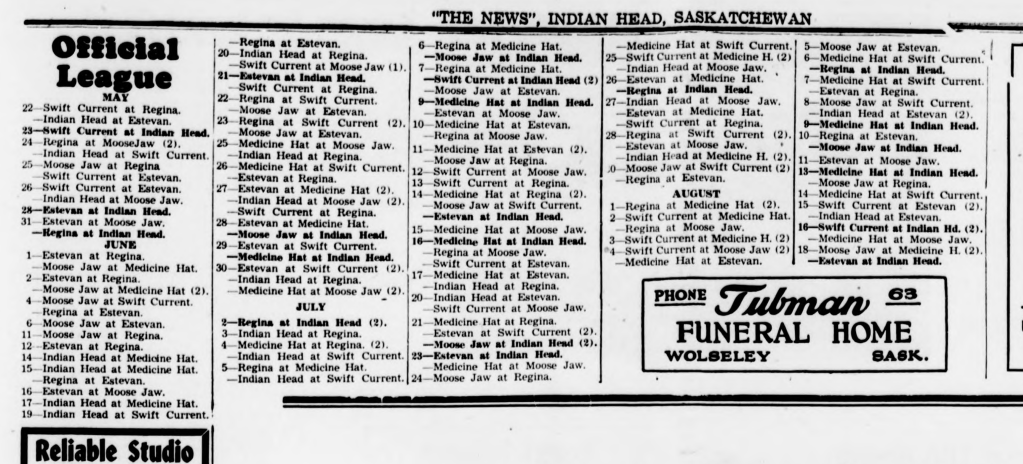
“They won three tourneys, shared top prize in another, and…the Rockets had triumphed in the Saskatchewan final and, in three tournaments, had whipped Sceptre in semi-final games. The Rockets didn’t sit still for long. When not in league games or tournaments, there was the exhibition circuit. In June, for example, the Rockets make a clean sweep of four games with clubs in the Northern loop — Delisle, North Battleford and Saskatoon” (attheplate.com)
Sceptre and Indian Head were at each other’s throats the whole season, but Sceptre finally gets sweet revenge at the Western Canada Championship sponsored by the National Baseball Congress.
As told by Sceptre pitcher/first baseman George Mahaffy to Jay-Dell Mah (attheplate) in a 2001 interview, how Hal Price and his old sore arm trick helped them capture the semi-pro title:
“…Hal Price pitched against the Indian Head Rockets and beat them. Next night, we’re in the finals against Indian Head … and Red Nixon comes out and says to me “Big George you’re pitching this.” Fergie Shields, backbone of our team … says “George, you go out and warm up and get a sore arm”. So I go out and it’s wet in Saskatoon, the old field on Avenue A, Cairns Field. So I just throw the hell out of the ball for five minutes, and my arm’s sore. So, Price is told to go as far as he can, and then we’ll do something else.” (attheplate.com)
It was an exciting year for Saskatchewan baseball, and Chet Brewer stirred the pot with his defection. Everyone wanted a piece of Brewer, but Indian Head finally won him over, and with his help, The Rockets went on to win an overall five tournaments, including Foam Lake:

And now, with photographic evidence, Chet Brewer’s ghost is no more, and his image can be proudly placed in IHM’s Rockets exhibit alongside his teammates.

Resources:
Jay-Dell Mah and attheplate.com
Indian Head Museum
Indian Head News
Medicine Hat News
Regina Leader-Post
Saskatoon Star Phoenix
Forgotten Heroes: Chet Brewer by Dr. Layon Revel and Luis Munoz (Center for Negro League Baseball Research)
Maureen Ulrich
Written by Robyn Jensen (October 2023) for her blog Home Runs & Dirts Roads


[…] Last year, for Halloween, I wrote a piece titled “Tales from the Dirt Road (Halloween Edition)—The Ghost of Chet Brewer. ” It was about discovering a photograph of Chet playing for the Indian Head Rockets in 1951. Brewer started playing mid-season for them (apparently snatched from Sceptre for a reported $800) and was not in the team photo, which was taken at its start, so he was a bit of an enigma. Where was there visual proof? It wasn’t until a community member came forward with a photo he found in his dresser drawer that a 72-year mystery was solved. You can read my article about it here: https://homerunsdirtroads.ca/2023/10/18/tales-from-the-dirt-road-halloween-edition/ […]
LikeLike